It's not just about philosophy: The Faculty of Arts at UCM opens its doors to future psychologists, teachers and interpreters
The offer is wide, the employment rate of graduates is high and diverse. Ethnologists, tourist guides, and passionate philosophers will also find their place.
You can find all accredited study programs here in this document, Admission requirements and further information can be found here on this page. The application deadline is April 30, 2026.
You can find a job right away after school
The employment of graduates of the Faculty of Arts (FF) of UCM is truly diverse. Graduates of non-teaching fields of study work in scientific research, in mass communication, editorial offices, publishing houses, cultural institutions, museums, archives, political institutions and representative bodies, in international companies, translation and interpreting institutions or as educational and managerial workers in the field of culture and education.
Graduates of the study field of teaching general education subjects in various combinations find employment as secondary school and university teachers, as primary school teachers, but they also work in various positions outside the educational sphere.

Innovative environment
FF UCM is a dynamic faculty that supports current trends and provides students with opportunities for practical application of knowledge. For example, as a result of the COVID-19 pandemic, the faculty established
Center for Psychological Counseling and Research, which, in addition to research and training, provides free psychological counseling, assistance and support in various life situations to students and employees. This is also proof that at the Faculty of Arts UCM innovative education is connected with practice.

The Department of Philosophy and Applied Philosophy boasts the prestigious Center for Bioethics, founded by Professor Peter Sýkora in 2008 as the first center of its kind in Slovakia. It focuses on research into the impact of modern technologies on humans, values, and society. It examines the problems that plague global society in the 21st century.
Other important centers at the faculty include:
Center for Historical Demography and Population Development,
Center for University Pedagogy,
Matej Bel Research Center.
There is a lot going on at the faculty, just take a look choose from a variety of programs and submit an application.
Special classrooms and laboratories for better practice
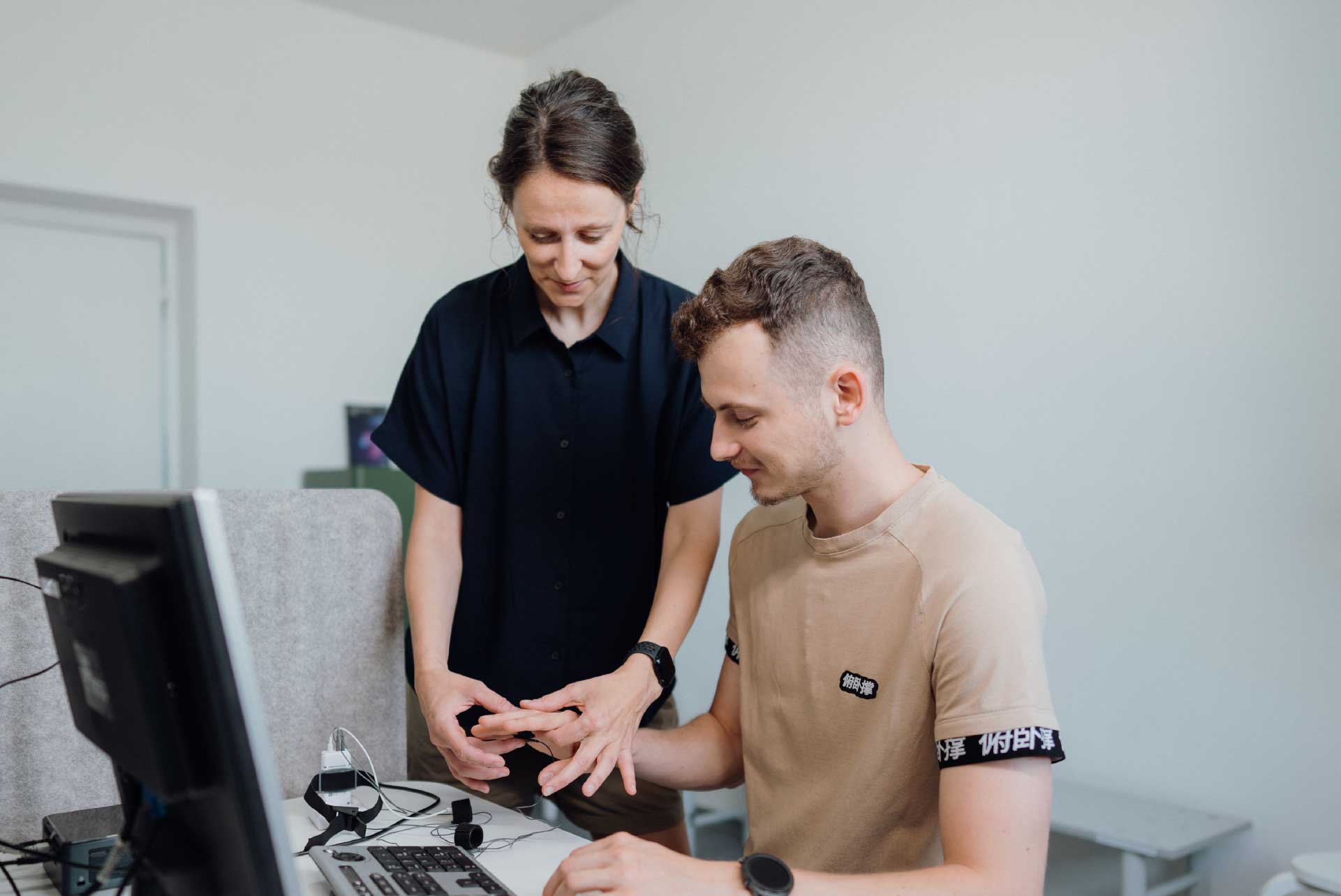
Several laboratories have been set up for experiments and scientific work. In the psychology laboratory, students can use various tests to diagnose intelligence or special abilities, such as fine motor skills, reaction time, memory, ability to concentrate under pressure, they can also test aggression, stress management and others. There is also a training room.
Students of teacher training programs have a pedagogical laboratory in which they improve their work with didactic techniques, develop their communication skills through video analysis and professional competencies by implementing micro-teaching and self-reflection.
The faculty also has a fully equipped interpreting laboratory, which contains professional translation booths. Students directly practice the basics of interpreting, and phonetics and phonology of foreign languages and communication skills are also taught here. The faculty offers the study of English, German and Russian in professional communication. Languages can also be studied within teacher training programs.

Rich student life
Of course, at the Faculty of Arts UCM it is not just about studying. We do not forget about student life, which also happens outside of school. Students are associated in various clubs and interest organizations. Lovers of words can express themselves in the student magazines Parazol or Via Historiae, while debaters can join the Psychoclub, which mainly brings together students from the Department of Psychology, who organize various discussions with teachers or professional debates.
Culture lovers and future ethnologists will be delighted by field research, as well as thematic meetings and discussions. Participation in foreign mobility within various programs during their studies is a matter of course for students.




Mohlo by vás tiež zaujímať: