New UCM Rector: I would like people to feel good at the university
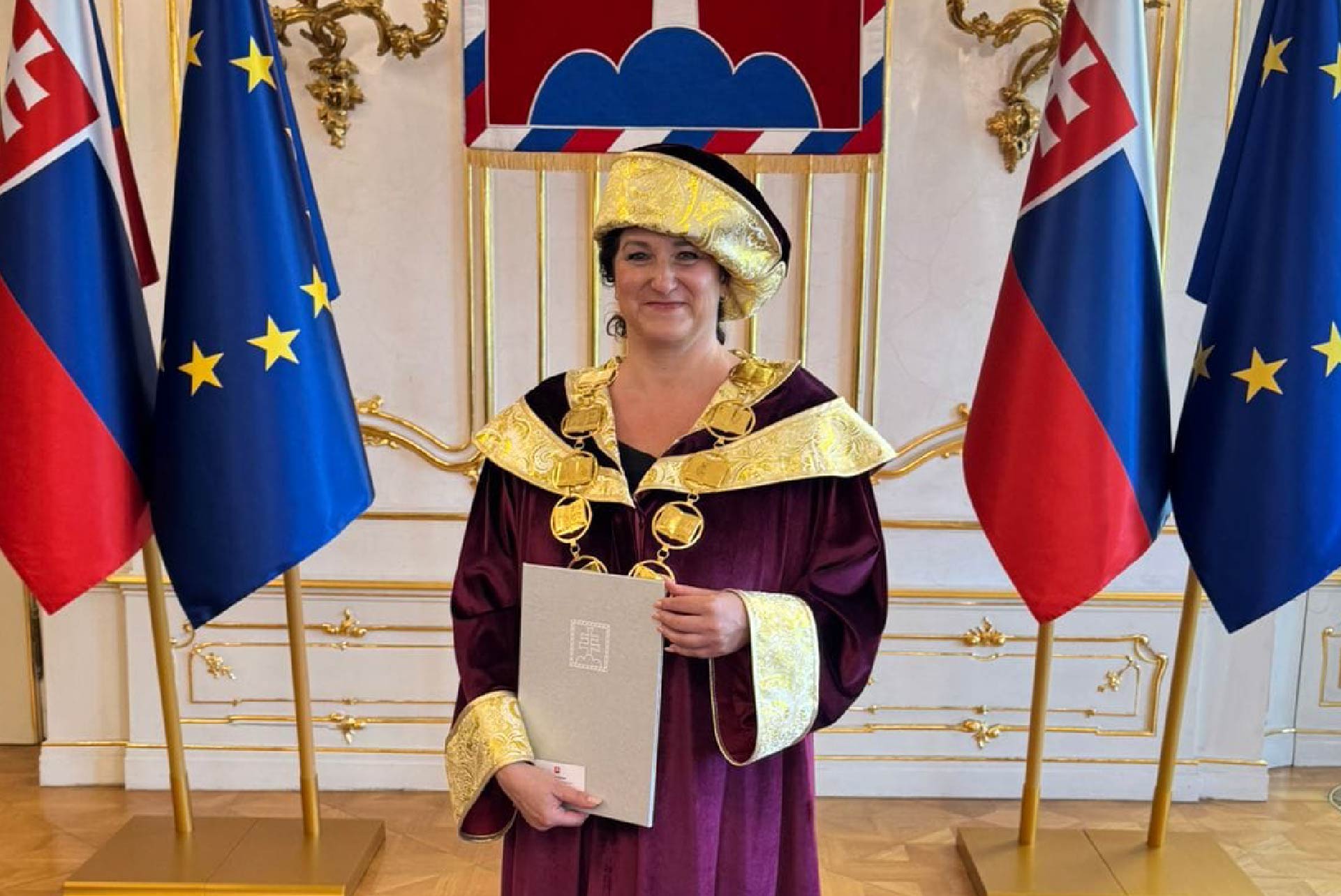
On Wednesday, May 20, 2026, President Peter Pellegrini appointed Associate Professor Iveta Dirgová Luptáková as the rector of the University of St. Cyril and Methodius in Trnava, leading it until 2030. In the interview, she outlines her vision of a more modern university, talks about cooperation between faculties, internationalization, and improving the atmosphere at UCM.
In the interview you will read:
- why she decided to run for rector of UCM and what she wants to change first at the university,
- what she wants to change in the atmosphere and communication at UCM,
- what plans does the UCM leadership have in the area of dormitories, internationalization, or cooperation with practice,
- why, in her opinion, universities should focus more on applied research and multidisciplinary projects,
- how she perceives the emergence of artificial intelligence in the academic environment and what she considers to be key when working with AI.
What was your main impulse to run for rector of UCM?
I have never seen the position as fulfilling personal ambitions. I rather think that if a person wants to change something, they must be ready to take responsibility. That is why I decided to run – I felt that some things at the university needed change and without the ability to make real decisions, this cannot be done.
I am the type of person who is not afraid to take on challenges. And yes, one of the impulses was dissatisfaction with the direction the previous university leadership was taking in some areas.

What would you like to change first?
The atmosphere at the university is very important to me. I would like the environment to calm down and for people to feel good – whether at the rectorate, the quaestorate or the faculties. I am a person who really enjoys working, but at the same time I need to work in an environment where normal relationships between people work. We should not feel that we have to avoid someone or that we do not want to meet someone in the hallway. If people are to work fully, they must feel good in the given environment.
The second topic is the quality system. I have said several times that it is currently set up very complicatedly. I do not say this as a criticism of one person – we were all involved in its creation. But the quality system must be a living organism and we must be able to look at what can be simplified and set up more functionally.
Which areas would you, on the other hand, like to build on?
Definitely the promotion and overall development of the university. I think that UCM has also moved forward in the area of identity and visibility in recent years. I know that not everyone always understands or identifies with the individual steps, but it is important to communicate about them and explain their meaning. Not every employee understands the visual identity, but the crown above the letter U has certainly helped us, today we are more visible and people associate us more with a specific brand. That is important.
The consortium and the development opportunities that the university has acquired were also a big step forward. Of course, more can always be done, but we managed to obtain funds thanks to which we can develop further.
I also consider the area of international relations to be very important. Foreign mobility has significantly increased – not only among students, but also among employees. And I consider that very positive. People have become accustomed to traveling, getting educated, bringing new experiences from abroad. It is a benefit that the university can offer to its employees, and I do not care at all whether the employee takes a family member with him/her – in the case of teaching and staff mobility, he/she usually completes activities in the morning, and has his/her free time in the afternoon. After all, even in Trnava we do not care who does what after working hours.
In some faculties, such as the Faculty of Natural Sciences, it is still necessary to motivate students more, but I think that we are gradually moving forward there too.


If you were to do a SWOT analysis of UCM, what would it look like?
I consider the Faculty of Mass Media Communication and the Faculty of Health Sciences to be very strong points. I think that these faculties will be the "drivers" in the future as well. Areas such as health, physiotherapy, but also psychology will be very relevant in the long term. In my opinion, FMK is a brand in itself - many may not even know UCM as a university, but they know mass media communication.
I still consider the weakness that many people in the region do not know that UCM operates in Trnava. Sometimes we remain in the shadow of Trnava University or the general designation "Trnava universities". We should be even more prominent and visible in the city and region itself.
And what about opportunities and threats?
I see great potential in cooperation with the city and region, but also in more intensive cooperation between universities in Trnava. We could do some activities together, which would have a greater impact and at the same time relieve us of the burden. We should be more part of the life of the city, I like events where the university "lives" together with Trnava and is naturally present in the public space - such as the UCM Night Run. There could be more such events.
Of the threats, it is clearly demographic development and the number of students. If the financing of universities continues to be significantly linked to the number of students, it will be a very sensitive topic for all universities. The second major factor is finances and the overall situation in higher education. We currently have significant financial resources available thanks to performance contracts, but in the future we must also be prepared for possible restrictions or consolidation.
In your program, you also mentioned organizational changes in the rectory and the quaestorate. What should we imagine by that?
I never talked about any mass layoffs, it is more about the logical setting of the functioning of individual departments and their management. Some departments today do not have a natural leader or clearly defined competencies. We therefore want to adjust the organizational structure to be more efficient and functional. The number of employees has increased significantly in recent years, which naturally also brings high financial costs. Therefore, it is necessary to look at it systematically and set up processes so that they make sense.
What will be your first steps after taking office?
For me, the most important thing was to create a quality team. I think it is not enough to have capable people, they must also be able to cooperate in a human way. If the management does not work with each other, it can be a big problem. In addition, we were also preparing organizational changes and the overall setup of the university's functioning - that is, how we want to lead individual areas and where we want to move them.
Did you select people for the university management based on expertise rather than on the representation of individual faculties?
Yes, definitely. I never had the ambition that each faculty had to have "its own" vice-rector. It was important for me that a specific area was covered by a person who was professionally oriented in it and could develop it.
Since we have communicated this with the people concerned, I can already reveal the names at this point. The Vice-Rector for Science and Research will be Professor Miroslav Ondrejovič from the Faculty of Arts, the Vice-Rector for International Relations will be Associate Professor Richard Brix from the Faculty of Arts, the Vice-Rector for Education and Quality will be Associate Professor Ľudmila Čábyová from the Faculty of Arts, and the Vice-Rector for Development and Promotion will remain Associate Professor Andrej Brník from the Faculty of Arts.
To what extent do you want to influence the direction of individual faculties?
One of the things that, in my opinion, has not worked systematically enough so far has been performance contracts. The Rector has a performance contract by law, and I think that a similar principle should also work towards faculty management. Each dean will therefore receive a performance contract, which will clearly define the goals and areas that a particular faculty should focus on. Each component has its strengths and weaknesses, and the university management must be able to name where it needs to work.
These areas will also be linked to measurable indicators that the university must meet within the framework of performance contracts and financing. Evaluation and remuneration will also depend on their fulfillment. In my opinion, it has often worked too “freestyle” so far. I would like the rules and expectations to be clearly stated and for everyone to know what is expected of them.
How do you want to motivate the faculties and the institute to cooperate more with each other?
Cooperation between individual parts of the university could be more intensive. However, it often depends mainly on people and their willingness to cooperate. We want to start supporting multidisciplinary projects more among doctoral students within the Doctoral Academy.
Today, there is almost no problem that can be solved only from the perspective of one discipline. Major challenges naturally require connecting different disciplines. Grant calls are also often built multidisciplinary today, so the university must be able to adapt to this.
How do you perceive the functioning of the rectorate departments in relation to the faculties?
Individual departments of the rectorate and the quaestorate must function as a professional service for the faculties. People in these workplaces are experts in their fields, but at the same time communication and mutual cooperation are very important. For example, in economic issues or public procurement, there must be natural communication between the faculty and the economics department. The dean is responsible for the functioning of the faculty, so he needs to have enough information and a partner for communication. This is one of the areas where we want to set up better functioning.

You also mentioned project departments. Are you planning any changes there?
It is a sensitive topic, because we all perceive that project support has been undersized for a long time. At the same time, it is not easy to get quality project managers to the university environment - people who can successfully write projects often have their own companies or work in an environment where they are financially significantly better valued. Therefore, we will also have to discuss how to set the conditions so that we can attract and retain such experts. At the same time, more systematic training of project managers in individual components has already begun, which I consider to be the right path.
A personnel audit was also conducted at the university, which showed that some employees are not too busy, while others are too busy. How do you view its results?
I do not completely agree with the audit. In my opinion, it was quite subjective in several moments. It often depended on how a person was able to present themselves and talk about their work, not on clear measurable indicators.
However, this does not mean that the problem does not exist. In every organization, there are people who work harder and people who are more likely to “get by”. It is important that managers know how to better distribute competencies and responsibilities within their teams. A completely ideal system will probably never exist, but we certainly want to work on making the functioning more transparent and efficient.
How do you want to approach the distribution of finances between faculties?
The university budget is not just mathematics. Of course, there are precise performance indicators, but at the same time the real needs of individual components must be taken into account. When creating the budget this time, we tried to set the system so that it was fair and sustainable at the same time. We distributed some finances according to performance, but we also took into account the specific needs of faculties and workplaces.
It is important that solidarity between components has clear rules. If a faculty needs help, there must also be a plan for what will be done to improve the situation in the future. A university can only grow when all its components grow.
Since the university is currently financially stable, do you plan to save more “for worse times”?
I am more of an optimistic type of person. Of course, we have to manage our finances responsibly, but I do not want to create an atmosphere of fear and constantly tell people that we just have to save. If we have the opportunity to develop the university, we should use it. However, it will be important to also manage well the large investment projects that we are currently solving within the consortium.
What changes in the university’s infrastructure do you consider the most important?
I do not think that the university needs to dramatically expand the number of buildings. Rather, we need to use the spaces we already have more efficiently and set up the functioning better.
In the long term, I think that the building on Bučianská should naturally serve as the rector’s residence. Today, workplaces are scattered and people are constantly moving between buildings, which is not efficient. At the same time, we want to think more about centralizing university premises in the future – adding something, building something – and we would like to acquire the building with the land in V jame.
One of the most frequent topics among students is dormitories. How do you want to address this area?
Dormitories are definitely one of our priorities. In the long term, I would like the university to have its own modern accommodation for students. We currently have several options – from cooperation with investors to various models of renting or reconstructing existing buildings. The possibilities of using other buildings in Trnava are also being discussed.
For us, the most important thing is that students have a place to live. If we want to be attractive to students from other regions of Slovakia, we must be able to offer quality accommodation. And above all, the most important criterion must be the method of allocating dormitories, so that it does not happen that, for example, a student from one faculty from Košice does not get a dormitory and, conversely, someone – to put it mildly – from Boleráz from another faculty gets one. The criterion must be kilometers, otherwise it makes no sense.
How does UCM want to attract talented students when many go to study abroad?
We must be honest that studying abroad is a natural part of young people's lives today. I wouldn't want to prevent them from doing so either; if I were young, I would also take advantage of this opportunity. Our task is to be attractive enough - not only for Slovak students, but also for foreign students. That is why I think that the future lies in a greater number of study programs in English. We must learn to operate more internationally. We have young people who speak foreign languages without any problems, and the university must be able to adapt to this.
At the same time, it is also a reality that there are many universities in Slovakia and fewer students. That is why we must learn to operate in a more modern way and also look for other sources of cooperation or financing.
How does the university want to strengthen cooperation with practice and companies?
We need to move more from purely basic research towards applied research and actually provide services to practice. Abroad, universities are a natural part of the economic environment and companies perceive them as partners. We now have to convince companies that we educate high-quality graduates and that we can be beneficial to them. And at the same time, we need to learn to look for new ways of financing and cooperation.
You also mentioned greater involvement in projects such as Horizon Europe. Is this one of the priorities?
Certainly yes. Slovak universities still draw less from these schemes than they could. However, I do not think that the problem is that our people are not professionally prepared. Rather, we need to learn to function better in international structures and not be afraid to enter such projects. We need to educate people more in project management and support them in gradually getting involved in international teams and consortia.
In your program, you also mention the creation of a unique research center. What can we imagine under that?
I do not want to reveal all the details yet, but it will be a multidisciplinary scientific center focused on applied research and cooperation with practice. Today, we already have projects on which several faculties cooperate - for example, FMK, FPV or FZV. And it is precisely this type of linking of disciplines that we want to further develop. The goal is for research results to not just remain “on paper”, but to have concrete practical use.
How do you want to advance scientific activity at UCM?
I think that research must be more strategic and systematic. It is not enough to just publish as many outputs as possible without a broader context. Individual components need more support in knowing what types of outputs make sense, which publishers are relevant and which direction is worth orienting.
And at the same time, I think that science should not be done just “for science”. It should also have a social or practical impact.
The term scientific integrity also appears in your program. What do you mean by that?
Above all, a responsible approach to scientific work. This means working honestly with data, not inventing results, citing correctly and approaching publishing ethically. We also want to support open science and greater transparency of research. I think that every researcher should feel personal responsibility for the quality of their work.
How do you perceive the emergence of artificial intelligence in academia?
Personally, I am not against AI. I rather see it as a tool that can help significantly – similar to the calculator once. The problem is not AI itself, but the way people work with it. We need to teach students and staff how to use these tools critically and responsibly.
Artificial intelligence is not automatically a guarantee of the right answer. One must be able to verify information, understand the context and work with quality sources. Therefore, I think that universities should also educate more on how AI works and how to use it effectively.

You also talked about internationalization. Would you like to cooperate more with strong Western universities?
Certainly. I think we need to strengthen contacts with Western universities and build partnerships that will be mutually interesting.
On the other hand, I do not think that high-quality cooperation automatically means only "the West". We also have very good experiences with smaller or less traditional countries and universities, which are often very motivated and open to cooperation. It is important to find partners with whom we can really cooperate and develop joint projects.
Your program also emphasizes work-life balance. Why is it important to you?
Because work is only one part of life. Even though I enjoy my work very much, a person must also have space for relaxation, family, sports or anything that helps them function mentally. Today's times are very fast and demanding, so I think that the university should also think more about the mental health of employees. And not only declaratively, but also through specific education or support activities.
It is often said that UCM is still struggling with certain stereotypes or political labels from the past, such as Mečiar University. How do you want to work with the reputation of the university?
One of my priorities is for the university to be apolitical and professional. I think this is also very important for credibility towards the outside world. Of course, some topics from the past are still associated with the university, but that is precisely why we have to take concrete steps that will show that we want to operate transparently and professionally.
You also emphasized more open communication in your program. How do you imagine it in practice?
I do not like an environment where information is unnecessarily concealed. I want things to be discussed more and for people to have the space to talk about problems. For example, in my opinion, the Rector's College should not function only as a place where the management passes on information. It should be a space for discussion and joint search for solutions. If we can establish more open communication at the management level, it will naturally be transferred to the faculties and workplaces.
What are you most looking forward to as the future rector?
I am sincerely looking forward to the fact that we may be able to make some real changes. That we will leave behind concrete results – more functional processes, a better atmosphere or a better functioning of the university. These elections were largely about change. And I would be happy if in four years people would say that they are no longer voting “against someone”, but that they are voting for a specific vision and specific leadership.


Mohlo by vás tiež zaujímať: